

Thinking about installing solar in New Jersey? One of the biggest financial benefits of owning a solar system is the ability to earn Solar Renewable Energy Certificates (SRECs). But despite being one of the most valuable incentives available, SRECs are also one of the most misunderstood.
Many homeowners believe SRECs are simply the extra electricity they don’t use. Others aren’t sure how to register, when they’ll receive payments, or whether they’ll even qualify.
This guide explains everything you need to know, including:
- Why homeowners considering solar should pay attention to the upcoming incentive reduction
- What SRECs are
- How New Jersey’s program has evolved
- The difference between SRECs and net metering
- How much SRECs are worth in 2026
- How to register your system
- How Public Service Solar handles the registration process
- How to sell your SRECs yourself or through Xpansiv (formerly SRECTrade)
- Which financing options allow you to keep your SRECs
What Are SRECs?
SREC stands for Solar Renewable Energy Certificate.
For every 1,000 kilowatt-hours (1 MWh) of electricity your solar panels produce, your system earns one SREC-II certificate.
These certificates have value because New Jersey requires electric suppliers to obtain renewable energy certificates as part of the state’s clean energy goals. Instead of producing renewable electricity themselves, utilities purchase SRECs from solar system owners.
Simply put…
Your solar panels save you money in two completely different ways:
- They reduce your electric bill through net metering.
- They earn additional income through SRECs based on how much electricity your system produces.
Those are two separate benefits.
The Biggest Misunderstanding About SRECs
One of the most common questions we hear is:
“Are SRECs just the extra electricity I don’t use?”
The answer is no.
SRECs are not based on excess electricity sent back to the utility.
Instead, they’re based on your system’s total production, regardless of where the electricity goes.
Imagine your solar system produces 10,000 kWh during the year.
Maybe:
- 5,000 kWh powers your home
- 5,000 kWh flows back to the utility
You still generated 10,000 kWh.
That means you’ve earned 10 SREC-II certificates, even though only half the electricity was exported to the grid.
SRECs vs. Net Metering
These two programs work together but serve different purposes.
| Net Metering | SREC-II Program |
|---|---|
| Credits you for excess electricity sent to the utility | Pays you for every 1,000 kWh your solar system produces |
| Appears on your electric bill | Paid separately |
| Helps reduce monthly electric costs | Provides additional income |
| Based on exported electricity | Based on total production |
Think of it this way:
Net metering measures where your electricity goes.
SRECs measure how much electricity your solar system makes.
A Brief History of New Jersey SRECs
New Jersey has long been one of the nation’s leaders in residential solar.
The original SREC program used a market-based system where certificate values fluctuated based on supply and demand. While some homeowners earned very high prices, values could also decline significantly.
To create more stability, New Jersey transitioned through several incentive programs before arriving at today’s Successor Solar Incentive (SuSI) Program.
Today, most new residential solar installations participate in the Administratively Determined Incentive (ADI) program.
Instead of uncertain market pricing, homeowners receive a fixed incentive amount for every SREC-II certificate generated.
This provides much greater predictability when estimating long-term solar savings.
Important Update for 2026: SREC Values Are Changing
If you’re considering going solar, timing matters.
The New Jersey Board of Public Utilities has announced that residential ADI incentive levels will decrease from:
$85 per SREC-II
to
$77 per SREC-II
for residential registrations received on or after July 27, 2026.
While an $8 difference may not sound significant, remember that SREC payments continue for 15 years.
Depending on the size of your solar system, this change can reduce the total value of your incentives by hundreds or even thousands of dollars over the life of the program.
Why homeowners shouldn’t wait until the last minute
Many people assume they simply need to install their solar system before the deadline.
That’s not how the program works.
There are multiple registration steps that must occur before your project is officially accepted into the program.
Waiting until the last few weeks before the deadline increases the risk that required paperwork or corrections could delay your registration.
That’s why Public Service Solar encourages homeowners interested in maximizing today’s incentive levels to begin the process as early as possible.
How Much Are My New Jersey SRECs Worth?
Now that you know what an SREC-II is, the next question is usually:
“How much money can I actually earn?”
The answer depends on two things:
- How much electricity your solar system produces each year
- The current New Jersey SREC-II incentive rate
Since you earn one SREC-II for every 1,000 kWh your solar system produces, larger systems that generate more electricity will naturally earn more certificates.
Most residential solar systems in New Jersey generate between 8 and 15 SREC-II certificates each year, depending on the size of the system and how much electricity it produces. At today’s $85 incentive level, that represents approximately $680 to $1,275 per year in SREC-II payments, in addition to your electric bill savings from net metering.
Use the calculator below to estimate how much your SREC-II incentives could be worth over the full 15-year incentive period.
Estimate Your 15-Year New Jersey SREC Value
Wondering how much your solar system could earn in New Jersey SREC-II incentives? Use the calculator below to estimate the value of your SREC-II payments over the 15-year incentive period.
Simply select your estimated solar system size to compare the current $85 per SREC-II incentive with the upcoming $77 per SREC-II incentive and see how the change could affect the total value of your incentives.
Estimate Your 15-Year SREC Value
Select your estimated system size to compare current SREC-II values with the upcoming reduced incentive.
$85/SREC-II
$77/SREC-II
Estimates assume approximately 1,200 kWh of annual production per kW installed. Actual production varies by roof direction, shading, equipment, and location.
Get My Free Solar EstimateLooking for an exact estimate? This calculator uses average production assumptions of 1,200 kWh per installed kW. During your free consultation, Public Service Solar will calculate your home’s exact production using professional solar design software, so you’ll know precisely how many SREC-IIs your system is expected to generate.
By registering after July 27, a typical 10 kW system could receive approximately $1,440 less in SREC-II incentives over 15 years.
How Do I Actually Receive My SREC Payments?
Many homeowners assume that once their solar panels are installed, they immediately begin receiving SREC-II payments.
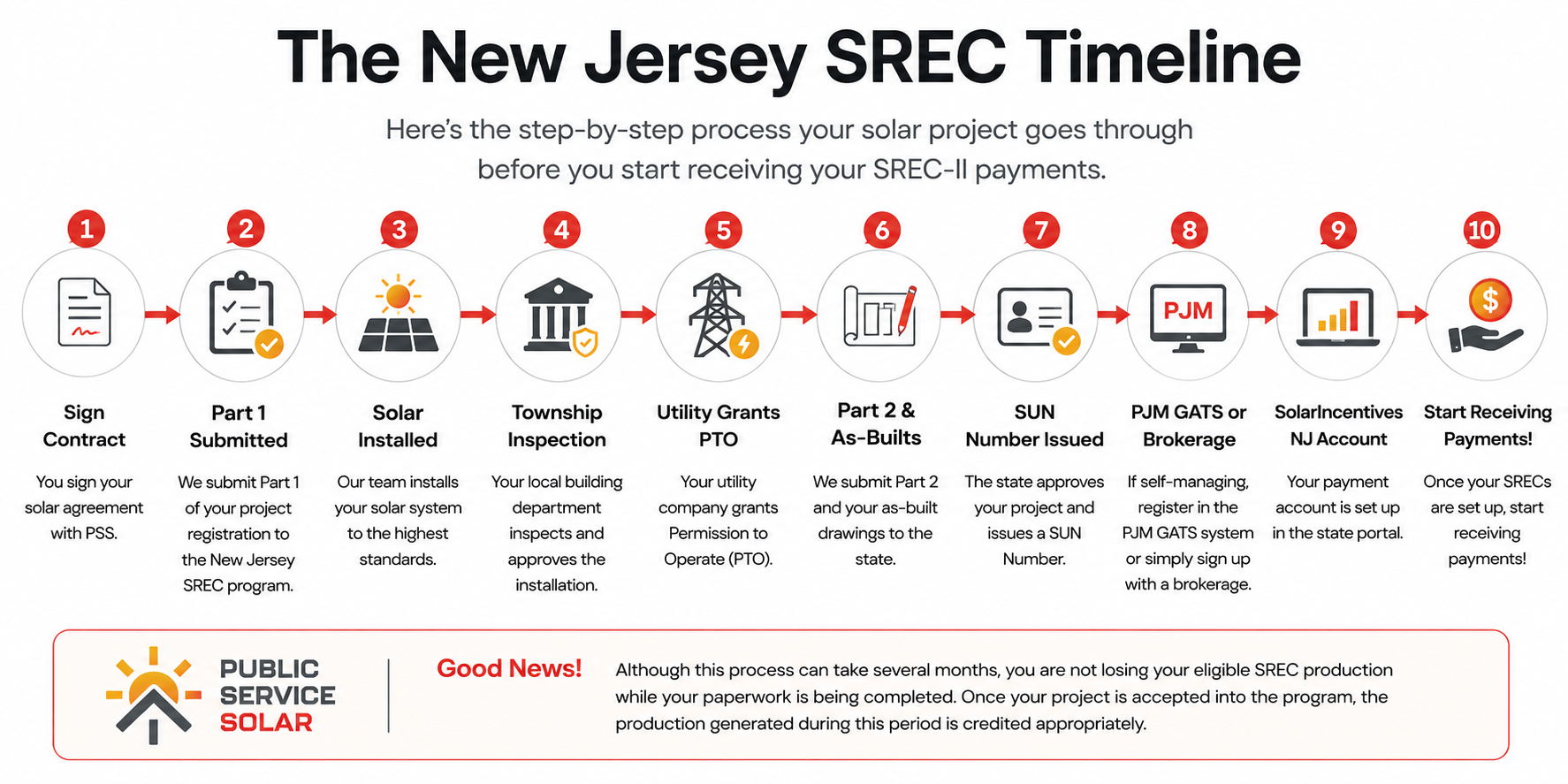
In reality, there are several important steps between signing your contract and receiving your first payment. Fortunately, Public Service Solar manages most of this process for our customers.
The timeline below shows what happens after you decide to go solar.
How Long Do You Receive SRECs?
Once your system is accepted into the ADI Program, eligible production earns SREC-II incentives for 15 years.
After that period, your solar system continues producing electricity and reducing your electric bills—you simply stop receiving SREC payments.
Fortunately, quality solar panels are expected to continue producing electricity for decades beyond the incentive period.
When Do You Start Earning SRECs
Another common question is:
“Do I lose production while my paperwork is being processed?”
Fortunately…
No.
Once your system receives Permission to Operate (PTO) and the project is accepted into the program, eligible production is credited appropriately even though your account setup may still be underway.
It often takes several months after installation before all registrations, approvals, account creation, and payment processing are complete.
The important thing to understand is that your production isn’t simply disappearing during that time.
How Public Service Solar Handles the Registration Process
The timeline above outlines the key steps required before you can begin receiving SREC-II payments. While the process may seem straightforward, it involves multiple organizations, detailed documentation, and several required submissions.
At Public Service Solar, we have dedicated employees whose primary responsibility is managing SREC registrations and helping ensure every customer’s project moves through the process as smoothly as possible.
Depending on your project, our team may assist with:
- Preparing and submitting the initial Part 1 registration
- Coordinating inspections and utility approvals
- Preparing and submitting the final Part 2 registration
- Creating and submitting accurate as-built drawings
- Responding to requests for additional documentation
- Helping customers understand their SUN Number
- Providing guidance for homeowners who choose to self-manage their SREC-II account or work with a brokerage such as Xpansiv
Although the registration process can take several months from installation to final approval, homeowners do not lose eligible SREC production while the required paperwork is being completed. Once your project has been accepted into the program, eligible production generated during this period is properly credited.
Having an experienced installer manage the registration process helps minimize delays, reduces paperwork for the homeowner, and provides peace of mind that every available incentive is being properly pursued.
What Is an “As-Built”?
An “as-built” is exactly what it sounds like.
It documents the solar system as it was actually installed on your home.
While the final installation often matches the original design, occasionally small adjustments are made during construction because of roof conditions, equipment placement, or other field considerations.
The as-built ensures New Jersey receives an accurate record of your completed solar installation before issuing final approval.
What Is a SUN Number?
Once your project has completed the registration process, it is assigned a SUN number.
Think of the SUN number as your project’s official identification within New Jersey’s incentive program.
You’ll need this number if you’re managing your own SREC reporting and payments and if you are using a brokerage.
Once everything is complete, you’ll use your SUN number during the registration process with PJM GATS and your payment platform if you’re not using an aggregator.
How Do You Sell Your SRECs?
Homeowners generally have two options.
Option 1: Use Xpansiv (formerly SRECTrade)
This is the option many homeowners choose because it’s simple.
Xpansiv helps facilitate the sale of your SREC-II certificates and handles much of the administrative work.
While there may be fees associated with using a broker, many homeowners appreciate the convenience.
Option 2: Manage Everything Yourself
If you prefer complete control, you can also manage your own certificates.
Generally, this involves:
- Receiving your SUN number
- Creating a PJM GATS account
- Registering your generator
- Reporting production
- Creating your payment account through SolarIncentivesNJ.com
While this approach requires more involvement, some homeowners prefer managing the process directly.
How Do You Get Paid for Your SRECs?
Once your solar system has been approved, registered, and your accounts have been created, you can begin receiving payments for the SREC-IIs your system has earned.
Unlike net metering credits, SREC payments don’t simply appear on your electric bill. Instead, they’re paid through New Jersey’s incentive payment system after your production has been reported and verified.
The exact timing of your first payment depends on several factors, including:
- How quickly your utility grants Permission to Operate (PTO)
- How long it takes for your registration to be approved
- When your SUN Number is issued
- Whether you’re managing your own SRECs or using an aggregator such as Xpansiv (formerly SRECTrade)
Because several organizations are involved, it’s completely normal for your first payment to take several months after your solar installation is completed.
How Often Are SREC Payments Made?
Many homeowners expect monthly payments similar to their electric bill, but that’s usually not how the process works.
Instead, production is accumulated, reported, verified, and then processed through the New Jersey incentive payment system.
If you’re managing your own SREC-II account, you’ll typically report your production through your PJM GATS account. Once your production has been certified, payments are made through SolarIncentivesNJ.com.
The exact payment schedule and reporting deadlines can change as program procedures evolve, so homeowners should always follow the current guidance provided through the New Jersey Clean Energy Program, PJM GATS, and Solar Incentives NJ.
What Is PJM GATS?
PJM GATS stands for the Generation Attribute Tracking System.
Think of it as the accounting system for renewable energy certificates.
Every qualifying solar system is registered within GATS, where its renewable energy production is tracked and certificates are created.
If you’re planning to manage your own SRECs instead of using an aggregator, you’ll create your own PJM GATS account after receiving your SUN Number.
Once your system is registered, you’ll use GATS to report production and create the SREC-II certificates that are ultimately submitted for payment.
What Is SolarIncentivesNJ.com?
While PJM GATS tracks and creates your certificates, SolarIncentivesNJ.com is where New Jersey processes incentive payments.
Think of it like this:
PJM GATS keeps track of what you’ve earned.
Solar Incentives NJ is where you get paid.
If you’re managing your own SRECs, you’ll create your payment account through SolarIncentivesNJ.com after your project has received its SUN Number and your PJM GATS registration has been completed.
How Does Public Service Solar Measure My Production?
Since SREC payments are based on production, one question naturally comes up:
“How do they know how much electricity my system produced?”
There are two common methods.
Some installers install a dedicated production meter specifically for SREC reporting.
At Public Service Solar, we install revenue-grade production current transformers (CTs) as part of your monitoring system. These CTs accurately measure your solar production while also providing homeowners with detailed production information through their monitoring platform.
That means you can see how much electricity your system is producing while also having accurate production data available for SREC reporting.
Can I See My Production?
Absolutely.
One of the biggest advantages of modern solar systems is the ability to monitor your production in real time. Using your monitoring app, you can see exactly how much electricity your system is producing each day, month, and year while tracking your lifetime production from an
Using your monitoring app, you’ll be able to view:
- Daily production
- Monthly production
- Annual production
- Lifetime production
- Historical trends
- Real-time system performance
Many homeowners enjoy tracking their production throughout the year, especially during the sunny summer months when solar output is at its highest.
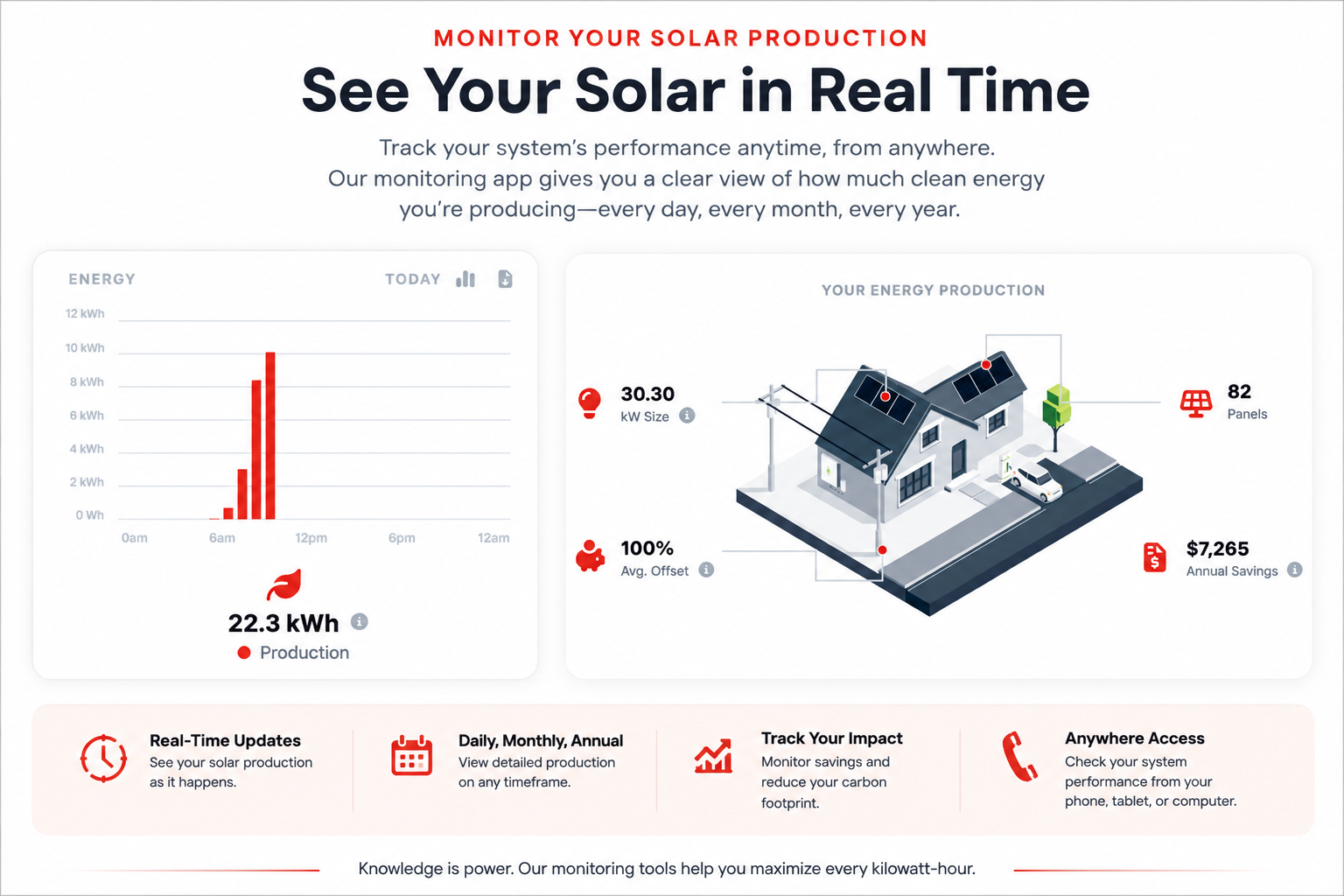
Public Service Solar customers can monitor their solar production in real time using their monitoring app, including daily, monthly, annual, and lifetime energy production.
Who Gets the SRECs?
This is one of the most important questions homeowners ask.
The answer depends on how your solar system is financed.
| Financing Option | Who Receives the SRECs? |
|---|---|
| Cash Purchase | Homeowner |
| Solar Loan | Homeowner |
| New Jersey Prepaid Lease | Homeowner |
| Traditional Monthly Lease | Third-Party Owner |
| Power Purchase Agreement (PPA) | Third-Party Owner |
Cash Purchase
When you purchase your solar system outright, you own the equipment and receive the SREC-II payments generated by your system.
Solar Loan
Financing your solar system with a loan also allows you to receive the SRECs because you still own the equipment.
New Jersey Prepaid Lease
One feature that makes New Jersey prepaid leases unique is that the homeowner still receives the SREC-II payments. Learn more about how a prepaid lease compares to ownership and PPAs.
This allows homeowners to enjoy a lower upfront system cost while continuing to benefit from the state’s production incentives.
Traditional Monthly Lease or PPA
With a traditional lease or Power Purchase Agreement, the third-party owner of the system typically receives the SRECs.
That doesn’t necessarily mean you’re missing out.
Instead, those incentives are generally incorporated into the lower monthly lease payment or lower per-kWh electricity rate offered through the agreement.
Common Mistakes Homeowners Make
Understanding how the program works can help you avoid unnecessary confusion.
Mistake #1: Confusing Net Metering with SRECs
These are completely separate programs.
Net metering reduces your electric bill.
SRECs reward your system’s production.
You receive both benefits when you own your system.
Mistake #2: Thinking You Lose Production While Waiting
Many homeowners worry that because their paperwork takes time, they’re losing SRECs.
Fortunately, that’s not how the program works.
Eligible production isn’t simply thrown away while your registration is being completed.
Mistake #3: Waiting Until the Last Minute
Because registration takes time, waiting until just before an incentive change can create unnecessary risk.
Beginning your project earlier gives your installer more time to prepare the required documentation.
Mistake #4: Trying to Handle the Paperwork Alone
Registering a solar system involves multiple organizations, multiple submissions, and detailed documentation.
Working with an experienced installer who understands the process can make everything significantly easier.
Why Homeowners Choose Public Service Solar
Installing solar is only part of the job.
Helping homeowners receive every incentive they’re entitled to is just as important.
That’s why Public Service Solar has dedicated employees who manage the SREC registration process from start to finish.
Our team helps coordinate:
- Part 1 registration
- Part 2 registration
- Utility coordination
- Final inspections
- Permission to Operate
- As-built documentation
- SUN Number issuance
- SREC registration assistance
- Ongoing customer support
Rather than asking homeowners to figure everything out themselves, we work behind the scenes to keep the process moving as efficiently as possible.
Frequently Asked Questions
Do I have to apply for SRECs?
Yes. Your solar system must be properly registered and accepted into New Jersey’s incentive program before you can receive payments. Public Service Solar handles the required registration process for our customers.
How many SRECs will I earn?
You’ll earn one SREC-II for every 1,000 kWh your solar system produces. A typical residential system may earn anywhere from 8 to 15 SREC-IIs each year depending on its size, orientation, shading, and annual production.
Do SRECs expire?
SREC-II incentives are available for 15 years after your project is accepted into the program.
Can I sell my SRECs myself?
Yes. Homeowners can manage their own PJM GATS account and payment registration if they prefer. Others choose to work with a brokerage such as Xpansiv for convenience.
Do batteries affect my SRECs?
No. Your SREC-II earnings are based on your solar system’s production, not whether you store electricity in a battery or send it back to the grid.
Ready to See Your Exact Solar Savings?
For many New Jersey homeowners, SREC-II payments represent one of the most valuable financial benefits of owning a solar system. Combined with net metering, lower electric bills, and rising utility rates, solar can provide decades of savings.
The calculator above uses average production estimates. Our solar designers use professional software to calculate your home’s exact solar production, projected SREC-II earnings, electric bill savings, and overall return on investment.
Whether you’re just starting your research or you’re ready to move forward, Public Service Solar is here to guide you through every step—from system design and installation to SREC registration and long-term support.
Get My Free Solar Proposal

